Technical Capabilities
Technical fit for QAs & Engineers
Validate how Autom integrates with your stack, understands your
tests, and delivers actionable release readiness insights. Connect signals across your systems
and translate them into a clear, business-readable release readiness view.
Testing Workflow
What Autom supports
 End to end processes
 Web
Web
 API
API
 Mobile
 Kafka/Event Flows
 Legacy/Desktop
End to end processes
Web
API
Mobile
Kafka/Event Flows
Legacy/Desktop
Legacy/Desktop
End to end processes
Web
API
Mobile
Kafka/Event Flows
Legacy/Desktop
How it works
From test inputs to release readiness
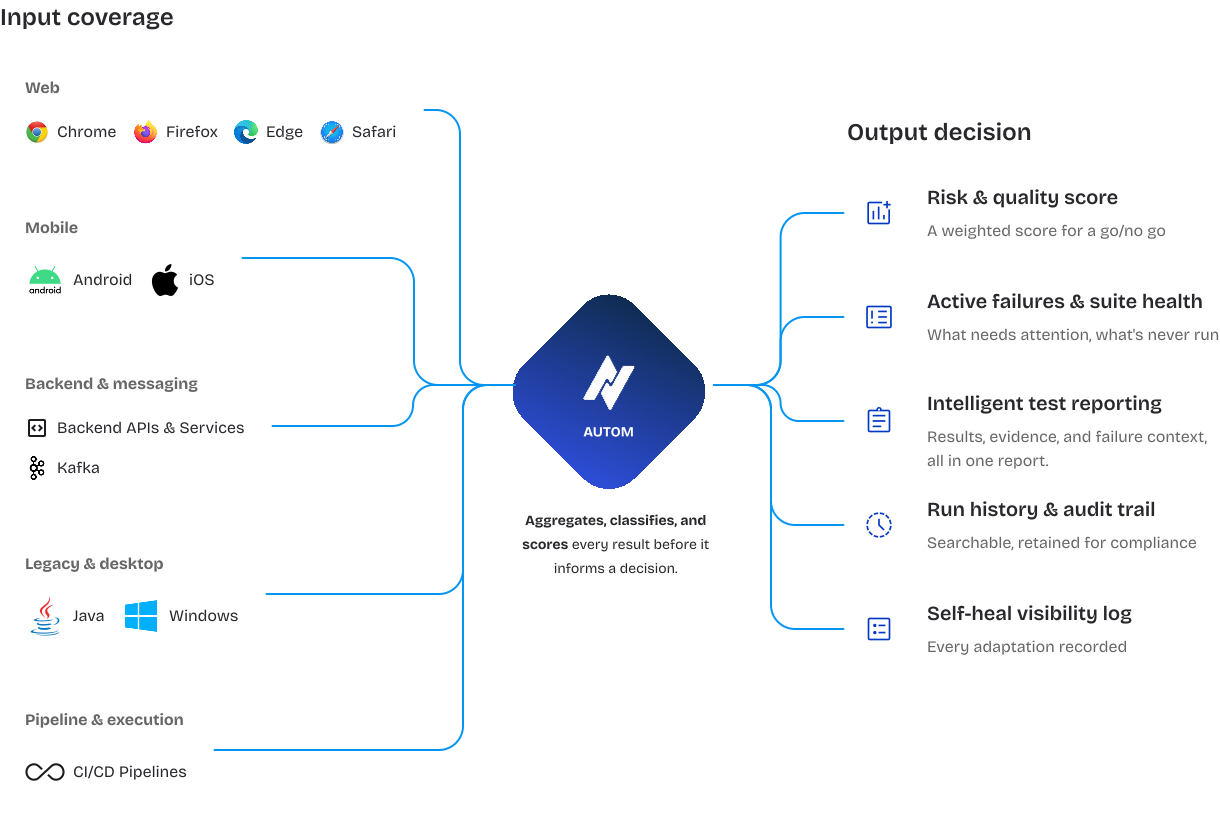
Input coverage
Web
 Chrome
 Firefox
 Edge
Edge Safari
Mobile
 Android
 iOS
iOSBackend & messaging
 Backend APIs & Services
 Kafka
KafkaLegacy & desktop
 Java
Java Windows
Pipeline & execution
 CI/CD Pipelines
Aggregates, classifies, and scores every result before it informs a decision.
Output decision

Risk & quality score
A weighted score for a go/no go

Active failures & suite health
What needs attention, what's never run

Intelligent test reporting
Results, evidence, and failure context in one report

Run history & audit trail
Searchable, retained for compliance

Self-heal visibility log
Every adaptation recorded
What teams can evaluate

Test coverage
Understand what's covered, what's missing, and the business impact.

Failure insights
Identify root causes faster with correlated logs, screenshots, and traces.

Suite health
Track flakiness, stability, execution time, and maintenance hotspots.

Release risk / readiness
Quantify risk and get clear Go / No-Go signals.
Why QA & engineering teams choose Autom
A clear technical view of what Autom adds beyond automation tools.

No-code test automation
Create, update and run automated tests without writing or maintaining scripts.
Record and model test flows faster, so QA teams can build automation without depending on heavy coding effort.

Framework-agnostic by design
Autom provides a consistent automation layer across different technologies, applications and test types.
Teams can standardize how tests are created, executed and maintained without making their testing approach dependent on one specific framework or implementation technology.

Self-healing to reduce maintenance
Reduce maintenance effort when UI elements or test conditions change.
Autom helps keep tests stable and lowers the amount of manual rework caused by brittle automation.

One automation layer across systems
Use the same platform across web, mobile, APIs, event flows, desktop and end-to-end processes.
Instead of managing separate tools and disconnected results for each channel, teams work with one consistent approach.
Deployment & security at a glance

Deployment options
 SaaS (Autom Managed)
Private cloud
On-premise
SaaS (Autom Managed)
Private cloud
On-premise

Access model
SSO (SAML / OIDC)
Role-based access
Least privilege

Auditability
Audit logs
Activity tracking
Exportable reports

Data handling
Encrypted in transit
Customer data isolation
Read-only by design
Evaluate technical fit with your team
Run a pilot, validate integration, and see real release readiness insight
Frequently asked questions
You can search for more questions below
Autom is an AI-powered Release Assurance Platform that turns fragmented test results and risk indicators into a clear, business-readable Go/No-Go decision before releases.
Autom is designed for organizations that develop, test, and release software in complex environments where quality, reliability, and release confidence are critical. Typical users include Engineering- and QA Leads as well as their Teams, Release Managers, Product Owners, Business Analysts, and IT Delivery Leaders. Autom is particularly well suited for banks, insurers, fintechs, insurtechs, and other regulated industries that need end-to-end visibility, traceability, and confidence before releasing software changes.
Release Assurance turns testing, quality, risk, and system dependency information into a defensible release decision.
Release readiness is the overall assessment of whether a software release can be deployed safely and confidently.
An evidence-based assessment of whether a software release should proceed.
Test automation automates the execution of tests and shows whether individual test cases passed or failed. It is an important capability within Release Assurance, but it does not provide the full picture. Release Assurance combines test results with coverage, dependencies, risks and other quality signals across the release process. This gives teams a consolidated, evidence-based view of whether a release is ready to go live..
Traditional test automation tools primarily focus on creating, executing and maintaining automated tests. Their main output is typically whether individual tests passed or failed. Autom includes test automation as a core capability, but adds the Release Assurance layer. It provides cross-system and cross-process coverage across web, mobile, APIs and Java-based legacy applications, and consolidates test results with coverage, dependencies, risks and other quality signals into a shared, evidence-based view of release readiness.
Getting started with Autom is typically very fast and requires minimal effort. Once access to the Autom portal has been provisioned, users can immediately begin creating and managing automated tests. For most use cases, no additional infrastructure setup is required. The main exception is mobile and legacy testing, which requires an on-premises setup and typically takes 1–2 days.
Test cases can be created in four ways: 1. Migration: Import existing test cases from scripts, spreadsheets or other sources. 2. AI-assisted creation: Generate and refine test cases with AI support. 3. Recording: Record user interactions and convert them into reusable test cases. 4. Manual creation: Build test cases directly in Autom using the no-code interface. This allows teams to reuse existing assets while choosing the most suitable creation method for each scenario.
Yes, Autom can replace existing testing tools by covering test creation, execution, management and Release Assurance within one platform. Migration is designed to be straightforward. Autom includes a built-in migration tool that helps transfer existing test cases from scripts or Excel into Autom, reducing manual rework and speeding up the transition. Where needed, we review the current setup together to ensure the right test assets and workflows are carried over efficiently.
Autom integrates with test automation frameworks, CI/CD pipelines, API, web, mobile, and legacy environments.
In many cases yes. Contact us so we can assess your specific environment and migration options.
Autom combines test automation, test orchestration and Release Assurance in one platform. Its core capabilities include end-to-end test automation across web, mobile, APIs, cloud, event-driven systems and Java-based legacy applications; orchestration across tools, environments and system boundaries; AI-assisted, recorder-based, manual and migration-based test creation; release readiness assessments with business-readable Go/No-Go guidance; release risk scoring; quality and test-suite health monitoring; self-healing tests; business risk dashboards; and integration with existing testing and CI/CD ecosystems. Together, these capabilities turn fragmented test results into a consolidated, evidence-based view of release readiness.
Yes. Autom supports end-to-end testing across web, mobile, API, cloud, java-based legacy, and event-driven-based systems.
Yes. Autom is designed to support the majority of enterprise legacy desktop applications. It leverages standard Windows accessibility technologies to automate applications built with common enterprise frameworks such as WinForms, WPF, and Java Swing/SWT. Together, these technologies cover a large share of legacy desktop applications used in enterprise environments. For more specialized technologies, such as Delphi-, Qt-, or SAP-based desktop applications, support depends on the specific application and environment. If you have a specialized legacy application, get in touch with us and we'll assess the best approach together with you.
Yes. Autom is designed for complex enterprise environments with multi-system business processes, distributed teams and heterogeneous technology landscapes. It is particularly suited to the BFSI industry, where critical workflows often span digital channels, APIs, event-driven architectures and Java-based legacy systems. Autom supports the scalability, traceability and release transparency required in regulated banking, insurance and financial services environments.
Yes. Autom includes a recorder function that allows users to create automated tests without coding.
No. Autom is designed as a no-code platform, allowing business users, QA teams and other non-technical stakeholders to create, manage and execute automated tests without writing scripts. More technical users can still benefit from integrations with existing tools, frameworks and CI/CD environments, while Autom provides a consistent interface across the testing and Release Assurance process.
Yes.
Autom is designed to make test automation accessible to both technical and non-technical users. As AI continues to simplify how software is created and operated, test automation is also moving increasingly toward no-code and AI-assisted approaches. Tests in Autom can be created through the no-code interface, by interacting with application elements, using the built-in recorder or with AI support. This removes the need to write scripts, manage dependencies or maintain automation code, allowing business users and QA teams to create and maintain tests independently. For supported Windows applications, Autom uses standard accessibility technologies, so no source-code access or complex setup is required. At the same time, its architecture remains extensible, allowing additional automation providers and deeper integrations to be added as requirements evolve.
AI is accelerating software development, increasing the volume of code and enabling more frequent releases. At the same time, quality signals are becoming more fragmented across tools, systems and teams, making it harder to maintain the bigger picture. Release Assurance combines test results with coverage, dependencies, quality and risk signals into one evidence-based view of release readiness. This helps organizations move at AI speed without losing control, transparency or confidence. Reliable functionality and defect-free releases are also an implicit customer expectation. When releases fail, the impact goes beyond technical remediation: customer trust, brand reputation and business continuity are at risk.
Autom helps organizations release faster and with greater confidence by reducing manual testing and release coordination effort, improving transparency and identifying risks earlier. Expected outcomes include shorter release cycles, lower QA and maintenance effort, freed engineering capacity, more reliable business processes, stronger traceability and a clearer basis for Go/No-Go decisions. By reducing failed releases and undetected defects, Autom also helps protect customer trust, operational continuity and brand reputation.
Autom consolidates test results, coverage, dependencies, quality indicators and release risks into one shared view of release readiness. Instead of relying on fragmented reports or pass rates alone, teams gain an evidence-based basis for the Go/No-Go decision. This creates greater transparency across QA, engineering, product and management, helps identify critical gaps earlier and reduces the risk of releasing unstable or incomplete functionality.
Yes. Autom translates technical testing information into business-readable insights.
Yes. Autom helps organizations reduce the manual work involved in testing, release preparation, release readiness assessments, and quality assurance activities. As a reference, at EcoHub, Autom helped reduce release readiness effort by 80%, accelerate the release cycle by 66% (from three days to one day), and free approximately 1.5 FTEs for higher-value activities. Results may vary depending on the organization's processes, testing maturity, and system landscape.
Autom is designed for organizations with different levels of release complexity, testing maturity, and system landscapes. Pricing depends on factors such as the number of applications, integrations, users, deployment model (SaaS, private cloud, or on-premises), and implementation scope. To provide an accurate proposal, we recommend booking contact us so our team can assess your specific requirements and prepare a tailored offer.
Autom provides traceability, audit trails, and release history
Autom offers flexible deployment options. Data can either be hosted by Autom or within your own infrastructure. When hosted by Autom, data is stored in Switzerland by default. Alternative data residency requirements, such as hosting within the European Union, can be evaluated based on your security, compliance and regulatory needs.
Yes. Autom can be deployed on-premises within your own infrastructure, making it suitable for organizations with strict security, compliance, governance, or data residency requirements.
Thanks, we got your question
Our team will reply to your email shortly.